

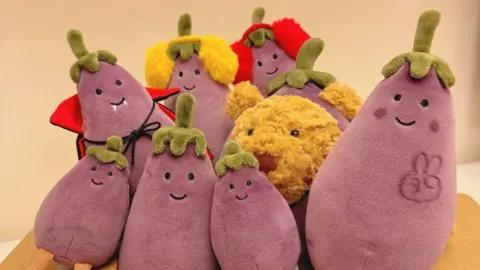
A woman named Stella acquired her first Jellycat brand plush toy during a period of unemployment in the pandemic. Encouraged by a friend's passion for these UK-created toys, her interest was fully captured when she saw an adorable gingerbread house design on a popular Chinese social media app.
While The Christmas holiday is not traditionally observed in China, being more of a commercial event rather than a religious festival, the imagery of gingerbread houses appealed with her. "The festival doesn't hold a lot to me... But I have always loved the appearance of gingerbread houses," she remarks. This prompted her to eventually request a friend from her hometown to buy the item on her behalf.
That purchase took place in 2021, just as Jellycat was about of achieving massive popularity in China and internationally. "People were anxious, and no-one knew what exactly was going to happen," says Stella, who developed a routine of petting and hugging her plushies for comfort throughout a difficult period. Residing in Beijing, a city with some of the strictest lockdowns globally, she passed extended periods at home.
Now aged 32 with a new job as a sales manager professional, Stella still grow her assortment. It has grown to approximately 120 items, with a total a cost of about 36,000 yuan. "As an adult, you have many things you can't discuss with others... and the problems we face are far more complex than in the past," she says reflectively. "The plushies assist me in regulate my emotions."
Initially created for children, these soft creatures have evolved into a global sensation, particularly within China where an somewhat disillusioned younger generation is turning to them for comfort and solace.
Understanding the Kidults
Her Gingerbread house toy belongs to the "Amuseable" line, a range of characters with tiny expressions inspired by commonplace items, ranging from bathroom tissue to boiled eggs. These toys have become the "breakout success" which "resonate with a broad younger adult demographic" around the world, as noted by market observers.
Their growing popularity "may have a connection to wanting for a sense of connection," suggest cultural commentators. While it's difficult to ascertain if the launch of the now-iconic series back in 2018 was a deliberate move to target the adult market, toy manufacturers are under pressure to need to find new markets due to declining fertility rates across numerous countries.
Jellycat entered China as early as 2015. Having laid the necessary "foundation", the toy maker was well-positioned to capture "the tone during Covid"—when people sought solace amid widespread uncertainty—capitalizing on its early momentum in the country, according to industry experts.
Its popularity was further boosted by engaging pop-up experiences. These in-store events sometimes offered a menu of limited-edition "food" themed items. Numerous enthusiasts record their experience interacting and share the videos online.
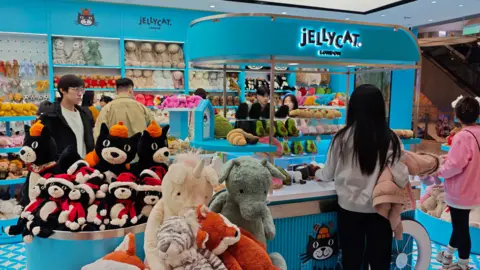
Localisation proved to be an essential approach. As an example, customers could purchase plush versions of classic British fare such as fish, chips and mushy peas during a pop-up in London. Conversely, products including teapot and teacup plushies were sold at exclusive stores in Chinese metropolises last year.
In 2024, the British firm's revenue is said to have increased significantly to reach a substantial sum. In that period, sales of an estimated $117 million worth of toys in China via leading online marketplaces, according to market intelligence estimates.
This growth reflects a broader surge within China's collectible toy market among adult consumers seeking emotional support and connection. Overall sales of collectable toys nationally are projected to top 110 billion yuan this year, as per a 2024 industry report.
The remarkable popularity of other toys such as Labubu, elf-like figures by Chinese toy maker Pop Mart, highlights the market's growing appetite towards designer collectibles. This "kidult" phenomenon isn't exclusive to China; adults worldwide are increasingly re-evaluate "traditional understandings of what it means to be an adult," note cultural experts.
Particularly, especially the eggplant plushie—nicknamed "the big boss" by Chinese fans—have also spawned numerous online jokes, where users expressing grievances regarding the pressures of adulthood. On social media, the "aubergine boss" tag serves as a platform where fans draw various emotive faces on the plushie, depicting it in various moods from drinking to forcing a smile.
For example, one Hong Kong-based, Wendy Hui, modified her eggplant toy by drawing bags under its eyes and placing a pair of glasses on the toy. She shared an image online captioning it: "The mood of employees on Monday." "I was working from home even on time off," she explains. "I just wanted to express how exhausted I felt."
Thus, Jellycat has become an unexpected, whimsical channel for China's youth to voice their frustrations over a slowing economy, where dedicated effort no longer ensure commensurate rewards. Despite strict online censorship, digital spaces have become an important, perhaps the primary, arena for such conversations.
The brand's regular releases of limited-edition designs coupled with the retirement of older designs—a strategy sometimes referred to as "scarcity marketing" locally—has further driven {


