

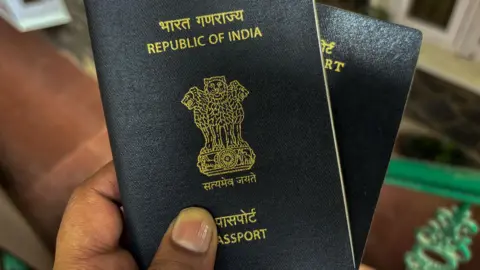
Earlier this year, an online clip from an Indian travel influencer complaining about the limited power of the Indian passport went viral on social media.
The influencer stated although nearby nations like Bhutan and Sri Lanka offered easier access to Indian tourists, securing travel permits to travel to many nations in Europe and the West remained a challenge.
Such concerns regarding the limited global access of Indian passports found confirmation in the latest Henley Passport Index, ranking the country at position eighty-five out of 199 countries, five spots lower compared to the previous year.
Officials in India has not commented regarding these findings so far.
Countries including Ghana, Rwanda and Azerbaijan with much smaller economies than India – which is the world's fifth biggest economy – hold better positions in the ranking in the seventies range, in that order.
Actually, India's rank over the last ten years has hovered around the eighties, falling to the 90th spot in 2021. Such standings are dismal when measured against other Asian countries like Singapore, Japan and South Korea, all maintaining top positions.
What Passport Strength Indicates
Passport strength indicates a country's global influence and global influence. This leads to better mobility for passport holders, improving commercial and educational prospects. A weak passport results in additional documentation, higher visa costs, reduced travel benefits and longer waiting times when journeying.
But despite the drop in position, the number of countries providing visa-free travel for Indian citizens has grown in the past decade or so.
For example, in 2014 – when the current administration's ruling party assumed office – fifty-two nations provided visa-free travel for Indian passport holders and its passport ranked 76th in the ranking.
A year later, it fell to eighty-fifth place, then rose to 80th in 2023 and 2024, declining once more to the 85th position this year. Meanwhile, visa-free destinations to Indian citizens grew from fifty-two eight years ago to 60 in 2023 and sixty-two this year.
The Competitive Global Mobility Landscape
The number of nations allowing visa-free entry in 2025 (57) is higher than what it was eight years ago (52), yet India's rank for both these years remains at eighty-fifth. So, why is that?
Analysts note that a primary factor is the increasingly competitive landscape in global mobility – meaning countries are entering into more travel partnerships to benefit their citizens and economic growth. According to a 2025 report, the global average count of countries travellers are able to access without visas has almost doubled from fifty-eight nineteen years ago to 109 in 2025.
As an illustration, The Chinese passport has expanded its count of visa-free countries available to its citizens from 50 to 82 over the last ten years. As a result, its position in the ranking has enhanced from ninety-fourth to sixtieth in that same duration.
Meanwhile, The Indian passport – previously positioned 77th on the index during summer – dropped to eighty-fifth place this autumn following the loss of two nations.
Other Influences Impacting Passport Power
A former Indian ambassador notes there are other factors that affect the strength of a country's passport, including its economic and political stability as well as its receptiveness to welcoming citizens from abroad.
For example, the US passport has fallen of the top 10 and now occupies twelfth place – a historic low – because of its increasingly insular stance in world politics.
The former ambassador recalls that during the seventies, Indian citizens had visa-free travel to numerous European and Western nations, though this shifted following Khalistan movement during the eighties. Subsequent political upheavals have continued to damage at India's image as a stable, democratic country.
"Many countries are also becoming increasingly wary of immigrants," the diplomat added. "India has a high number of citizens emigrating overseas or remaining beyond visa limits affecting the country's reputation."
Elements like how secure a country's passport is and its immigration procedures also play a role to obtaining visa-free entry to other countries.
Security and Technological Improvements
The Indian passport remains vulnerable to security threats. In 2024, law enforcement arrested 203 people for alleged passport and visa irregularities. The country also has cumbersome immigration procedures with lengthy timelines for visa approvals.
The diplomat indicated that technological advances, such as the newly introduced electronic passport or e-passport, may enhance safety and ease the immigration process. This electronic document contains a small chip holding biometric information, increasing difficulty to forge or tamper with the passport.
However, increased diplomatic efforts and travel agreements continue essential to boosting the global mobility of Indians and consequently, the Indian passport's global position.


